When you walk into one of our nurseries, you might not immediately see a traditional “lesson”.
You might see a baby repeatedly dropping an object and waiting for a familiar adult to return it. A toddler could be completely absorbed in transporting water from one container to another. Outside, children might be digging, balancing, investigating something they have found or turning an ordinary collection of loose parts into something entirely different.
In another space, a group of children might be building together. Their tower falls. Nobody rushes in to fix it. Instead, an adult pauses, watches and gives them the time to think about what they could do differently.
To us, this is learning.
At Sweet Peas, we believe children are capable, curious researchers and problem-solvers. Our curriculum gives them roots and wings: the security, relationships and sense of belonging they need to feel safe, alongside the independence, confidence and curiosity to explore their world.
Learning through play isn’t an alternative to teaching. It is how much of our teaching happens.
Our curriculum starts with the child
Our curriculum has clear intentions for what we want children to learn, experience and understand during their time with us. But we don’t believe that means every child should be doing the same activity at the same time.
Children bring their own experiences, families, interests, personalities and starting points into nursery.
Our job is to know them.
We think about what a child already knows, what they are showing us now and what they might be ready for next. Our planning gives us direction without becoming a fixed programme that children have to fit into.
Sometimes learning develops exactly as we expected. Sometimes a child’s question, discovery or fascination takes us somewhere completely different.
We value both.
That’s why you’ll often hear us talking about following the child without losing the intention.
Find out more about our curriculum.
Play with purpose
Children don’t separate their learning into subjects.
When a child spends twenty minutes building a tower, they aren’t simply “playing with blocks”.
They are investigating balance, size, position and shape. They might be comparing, counting and estimating. They are developing hand control and coordination.
When the tower falls, something equally important happens.
Do they give up? Try again? Ask for help? Change their idea?
That is where we see resilience, problem solving and confidence developing.
Add another child and suddenly there is communication, negotiation, turn-taking and collaboration too.
One experience can hold an enormous amount of learning.
The same is true when children pour water, mix mud, make marks, build dens, care for dolls, create imaginary worlds, sing songs or spend ten minutes watching an insect outside.
We don’t need to constantly move children onto the next activity to prove that learning is happening.
Sometimes the most valuable thing we can give a child is time to stay with an idea.
Repetition isn’t “doing the same thing again”
Children repeat experiences because repetition is how learning becomes secure.
A toddler may fill and empty the same container again and again. A baby may repeatedly press something just to hear the sound it makes. A preschool child may build essentially the same structure for several days.
To an adult, it can look repetitive.
To the child, something is changing each time.
They are predicting, testing, adjusting and beginning to understand cause and effect. They are becoming quicker, more coordinated or more confident. Eventually, they may introduce a completely new idea because the previous learning has become secure.
Our curriculum therefore protects children’s opportunity to revisit, practise and consolidate rather than constantly replacing experiences with something new.
The adult matters enormously
Child-led doesn’t mean adult-absent.
One of the most important parts of our curriculum is the role of the adult.
Our team observe, listen and think carefully about what is happening in children’s play. Sometimes the best thing an adult can do is join in. Sometimes it is to introduce a new word, model an idea or wonder aloud:
“I wonder what might happen if…”
Sometimes a child needs reassurance or help regulating an emotion before they are ready to explore again.
And sometimes the most skilful thing an adult can do is pause and say nothing at all.
We don’t want adults constantly questioning children or taking over their ideas.
We want meaningful interactions.
An adult might model richer vocabulary, comment on what they notice, introduce another resource, help children solve a disagreement or gently extend an idea. They give children processing time and listen properly to the response.
That balance between knowing when to step in and when to step back is a huge part of skilled early-years practice.
Our environment is part of our curriculum
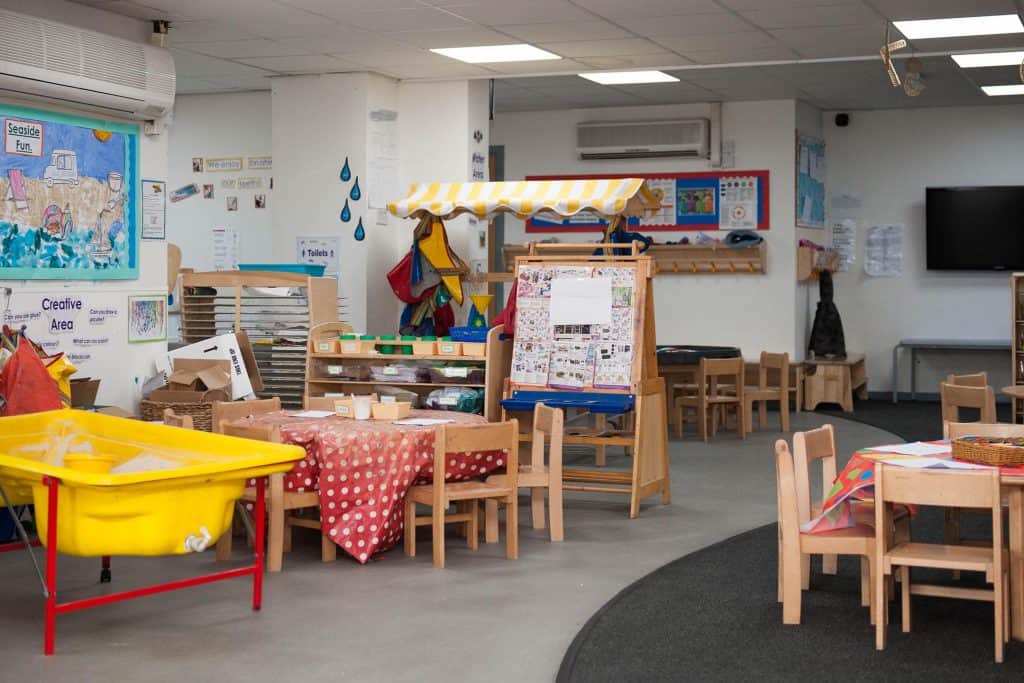
We think carefully about our nursery spaces because the environment sends powerful messages to children.
Can I reach this myself?
Am I allowed to choose?
Can I move this?
Can I come back to it tomorrow?
Can I find somewhere quiet when everything feels too much?
Our environments are designed to feel warm, calm and homely, while still being full of possibility.
That is what our Hygge-inspired approach means to us. It isn’t simply about how a room looks. It is about creating a feeling of belonging, security and togetherness.
Resources are thoughtfully chosen and accessible so children can make meaningful choices and develop independence. We particularly value open-ended resources because they don’t tell children what the “right” outcome should be.
A wooden block can become a phone, a cake, a bridge or part of an enormous construction.
The resource hasn’t decided what the child should learn.
The child has.
Independence starts much earlier than school
School readiness at Sweet Peas isn’t about pushing school down into nursery.
We want children to leave us with strong foundations for whatever comes next.
That starts right from our Baby Suites.
A baby’s first attempts to reach for something, communicate a need or explore away from their key person are early forms of independence.
As children grow, those opportunities grow with them.
Choosing resources. Pouring their own drink. Putting something away. Having a go before asking an adult. Finding their belongings. Making choices. Managing clothing. Helping a friend. Expressing an opinion. Solving a problem.
These everyday moments matter.
By preschool, we want children who increasingly believe:
“I can have a go.”
That confidence is far more valuable than rushing children towards formal learning before they are ready.
Relationships come before everything else
None of this works without secure relationships.
A child who feels safe is much more able to explore.
This is why our key-person relationships, predictable routines and emotionally available adults are such an important part of our curriculum.
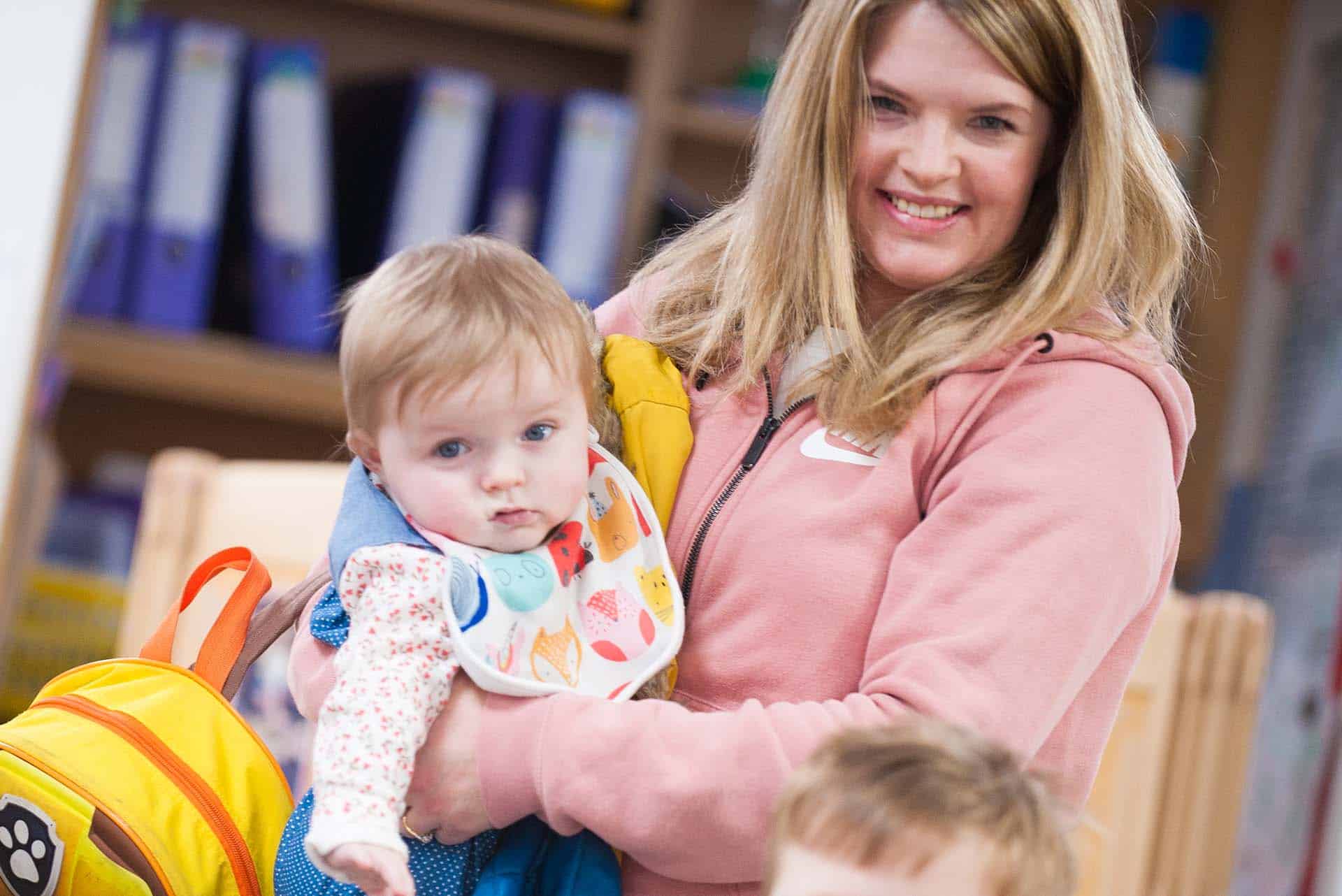
For our youngest children especially, learning often happens within the relationship itself — through eye contact, imitation, songs, gestures, shared attention and responsive conversations.
As children grow, adults continue to help them understand emotions, friendships and boundaries.
When things go wrong, our role isn’t simply to stop behaviour. We help children connect, regulate, understand what happened, repair relationships and gradually develop the skills to manage these situations themselves.
Those are learning moments too.
Communication is everywhere
Communication isn’t something we save for group time.
It happens over breakfast. During nappy changing. While putting on a coat. Building outside. Sharing a story. Finding a worm. Sitting beside a child who is upset.
Our adults model language naturally throughout the day. They introduce new vocabulary, repeat and extend children’s words, sing, tell stories and create opportunities for genuine conversation.
And communication doesn’t look the same for every child.
We use gestures, visuals and other communication supports where children need them because inclusion isn’t about expecting every child to access nursery in exactly the same way.
It’s about making sure every child can belong, communicate and participate.
Group times have a purpose
We love spontaneous learning, but our curriculum isn’t entirely spontaneous.
There are things we intentionally want children to encounter.
Stories, songs, rhyme, mathematical language, new vocabulary, cultural experiences and shared conversations all have an important place within nursery.
Our group experiences therefore have a purpose, but we think carefully about children’s ages, development and ability to engage.
A meaningful five-minute experience can offer far more learning than expecting young children to sit through a twenty-minute adult-led activity simply because it appears educational.
Quality matters more than length.
Our Community, Our Heritage, Our Future
Our curriculum reaches beyond the nursery walls.
We want children to understand that they belong to a family, a nursery and a wider community.
Children should encounter their own lives within our environment, but they should also discover experiences beyond them.
We introduce children to different families, cultures, celebrations, occupations, places and ways of living. We explore our local communities and make use of the world immediately around our nurseries.
We call this:
Our Community. Our Heritage. Our Future.
It helps children develop a strong sense of who they are while beginning to understand and value a world much bigger than themselves.
Outdoors is learning too
Outdoor learning isn’t simply indoor provision moved into the garden.
Outside gives children experiences that can’t be recreated in exactly the same way indoors.
They can move differently. Take appropriate risks. Dig. Carry. Climb. Balance. Investigate weather. Encounter living things. Notice seasonal change. Build on a much bigger scale.
At Sweet Peas Garforth, this includes our Nature Suite, where sand, bark, soil, water, planting and natural materials give children opportunities to investigate the changing natural world.
At Sweet Peas Rothwell, our environments similarly give children opportunities to explore, create and follow their ideas using carefully considered, open-ended resources.
We want children to experience the outdoors as somewhere they belong and learn, not somewhere they simply visit when the weather is nice.
What does all of this actually look like?
Often, it looks wonderfully ordinary.
It is the child who has tried six times to fasten their coat and finally manages it.
The baby who crawls away from their key person to investigate something and then looks back for reassurance.
The toddler who suddenly uses a word an adult has been modelling for weeks.
The children who disagree over the same resource and, with support, begin finding a solution.
The child who notices that the ice they brought indoors has disappeared and wants to know where it went.
The tower that falls down for the fifth time — followed by:
“Again!”
Those moments are why we don’t measure the quality of a nursery day by how many adult-led activities have been completed or how many identical pieces of artwork go home.
We look more deeply.
Were children curious? Did they communicate? Did they make choices? Did they persevere? Did they feel safe enough to explore? Did an adult recognise an opportunity and know what to do with it?
That’s learning through play at Sweet Peas.
Come and see it for yourself
When parents visit Sweet Peas, we don’t expect them to see children performing for a tour.
We want them to see real nursery life.
Children deeply involved in their play. Familiar adults down at their level. Babies feeling secure enough to explore. Toddlers proudly doing something for themselves. Preschool children developing ideas together. Calm spaces alongside busy ones. Adults laughing, talking, modelling, listening — and sometimes deliberately stepping back.
Because our aim isn’t simply to prepare children for the next room or even for school.
It is to give them roots and wings: strong relationships, communication, independence, curiosity, confidence and a genuine love of discovering what they can do.
That’s what learning through play really means to us.
Book a nursery tour and visit Sweet Peas Garforth or Sweet Peas Rothwell to see our curriculum in action.